
Drivers endure high gas prices despite US oil boom

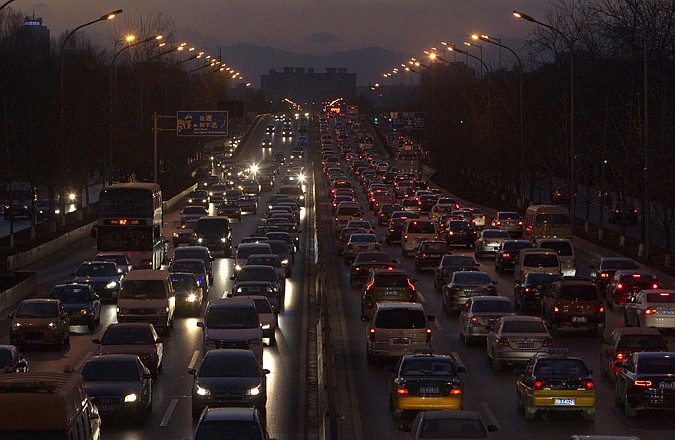
Vehicles pack a main road during rush hour in Beijing. China, which overtook the U.S. late last year as the world’s largest oil importer, has the single biggest influence on global demand for fuels.

Vehicles pack a main road during rush hour in Beijing. China, which overtook the U.S. late last year as the world’s largest oil importer, has the single biggest influence on global demand for fuels. Photo by The Associated Press.

NEW YORK (AP) — The U.S. is increasing its oil production faster than ever, and American drivers are guzzling less gas. But you'd never know it from the price at the pump.

The national average price of gasoline is $3.69 per gallon and forecast to creep higher, possibly approaching $4 by May.

"I just don't get it," says Steve Laffoon, a part-time mental health worker, who recently paid $3.59 per gallon to fill up in St. Louis.

U.S. oil output rose 14 percent to 6.5 million barrels per day last year — a record increase. By 2020, the nation is forecast to overtake Saudi Arabia as the world's largest crude oil producer. At the same time, U.S. gasoline demand has fallen to 8.7 million barrels a day, its lowest level since 2001, as people switch to more fuel-efficient cars.

So is the high price of gasoline a signal that markets aren't working properly?

Not at all, experts say. The laws of supply and demand are working, just not in the way U.S. drivers want them to.

U.S. drivers are competing with drivers worldwide for every gallon of gasoline. As the developing economies of Asia and Latin America expand, their energy consumption is rising, which puts pressure on fuel supplies and prices everywhere else.

The U.S. still consumes more oil than any other country, but demand is weak and imports are falling. That leaves China, which overtook the U.S. late last year as the world's largest oil importer, as the single biggest influence on global demand for fuels. China's consumption has risen 28 percent in five years, to 10.2 million barrels per day last year.

"There's an 800-pound gorilla in the picture now — the Chinese economy," says Patrick DeHaan, chief petroleum analyst at the price-tracking service GasBuddy.com.

U.S. refiners are free to sell gasoline and diesel to the highest bidder around the world. In 2011, the U.S. became a net exporter of fuels for the first time in 60 years. Mexico and Canada are the two biggest destinations for U.S. fuels, followed by Brazil and the Netherlands.

Two other factors are making gasoline expensive:

— High oil prices. Brent crude, a benchmark used to set the price of oil for many U.S. refiners, is $108 per barrel. It hasn't been below $100 per barrel since July. On average, the price of crude is responsible for two-thirds of the price of gasoline, according to the Energy Department.

— Refinery shutdowns. Refineries temporarily close in the winter, when driving declines, to perform annual maintenance. That lowers gasoline inventories and sends prices higher nearly every year in the late winter and spring.

Rising gasoline prices act as a drag on the economy because they leave less money in drivers' wallets to spend on other things. But because average prices have remained in a consistent range — between $3 and $4 per gallon since the end of 2010 — economists say their effect on growth has been minimal.

Drivers in Connecticut, New York and Washington, D.C., are paying $3.92 or more per gallon on average, according to the Oil Price Information Service. Drivers in Rocky Mountain states, where refineries can tap low-priced crude from the U.S. and Canada, are paying far less. Gas costs $3.42 or less in Wyoming, Utah and Montana.

For the year, prices are forecast to average $3.55 per gallon, slightly lower than last year's record average of $3.63. The peak for 2013, likely to come this spring, is expected to fall slightly short of last year's peak of $3.94.

A major reason cited for high gasoline prices over the last two years — fighting and political tensions in the Middle East and North Africa — doesn't apply this year. Libyan production has returned after collapsing during the country's revolution two years ago. And higher production from the U.S. and Saudi Arabia has made up for Iran's declining output in the face of Western sanctions.

David Haeussermann, a police dispatcher in Tampa who recently paid $3.56 per gallon to fill his Kia Rondo, hasn't had a raise in six years. He says higher prices for gasoline and food in recent years have prompted him to cut back on dinners out and to settle for less fancy food at home. He doesn't understand why gasoline costs so much, but by now he's used to it.

"Three-dollar gas seems to be a dream right now," he says.

The good news is that the national average price is 15 cents lower than last year at this time, because of slightly lower oil prices and less concern over the situation in the Middle East. But disruptions at refineries or pipelines, or threats to oil supplies around the world, could send gasoline prices sharply higher at any moment, analysts say.

Lafoon, the St. Louis man, consolidates trips and drives as little as possible to blunt the effect of high prices. And he never fills all the way up. It is an exercise in what he calls "magical thinking" — that prices aren't really what they are.

Hey, it's worth a try.

Comments

JCLifer 2 months, 4 weeks ago

What choice do drivers have? With local and state governments cutting public transit services, and jobs getting harder to find, people will continue to struggle to get to work by driving expensive cars and paying for expensive gasoline. Many folks have to drive long distances to even find a job.

0

wyriontair 2 months, 4 weeks ago

Prior to the 2008 election when gas was over $2 a gallon, the press and Democrats and then candidate Obama were screaming "it's all George Bush's fault" They all excoriated him and all Republicans, when gas went below $2 everyone still went after him. Fast forward, 2009 prices were starting to climb higher and higher, I didn't hear ONE Democrat or News Organization go after this President, they suddenly said he doesn't have any control over gas prices, it's the fault of an earthquake, hurricaine, tsunami, turmoil in the middle east, it was one excuse after another. Yes, there is more drilling on "PRIVATE" land but virtually non-existent on "PUBLIC" lands. Now the regulations are excessive, the Dept of Interior, Dept of Energy, and other agencies have, for the most part, stopped granting companies permits to drill. If you want lower prices, I suggest you stop whining about it and call your Senators and Representatives and tell them to start doing their jobs and tell those agencies to stop ruining our economy.

0

JCLifer 2 months, 4 weeks ago

Gasoline is: $3.49 in Jefferson City, but only $3.44 in Columbia; $3.45 in California and Tipton; $3.39 in Eldon; $3.31 in Camdenton; $3.36 in Sedalia.

News Tribune ought to do a story and find out why gasoline prices are always higher in Jefferson City.

0

3blindmice 2 months, 4 weeks ago

Prioritize. How many trips do you take that are less than a couple of miles? For those trips walk or use a bike. In Fremont I walk to everywhere I go. As for the trips you must use a vehicle I would look into converting to a natural gas run vehicle.

0

Wspahn 2 months, 4 weeks ago

JCLifer, you are rocking the JC oil cartels boat. An extra dime a gallon times tens of thousands of gallons a year is a nice bonus going to the cartel's cheif members. That is how they roll here in town. Nobody will talk about it, but hey we need a convention center. How about asking the gas suppliers for some money to build it.

0

JCLifer 2 months, 4 weeks ago

Uh, your numbers are probably a little low. Let's take a look here: Assume an extremely conservative 4 tanker trucks of fuel is sold per day in Jefferson City, and each tanker truck holds 6,000 gallons of fuel- that equals 24,000 gallons of fuel a day. At 10 cents a gallon more, they are raking in $2,400 additional rape dollars per day. Multiply that times 365 days, and you can see that they are raping the Jefferson City economy of nearly a million dollars a year EXTRA. Yes, the cartel is stealing a million dollars out of the jefferson City economy per year, and no one blinks an eye.

Assume we are really using 10 tank trucks per day, the number being skimmed from Jefferson City residents and the local economy approaches 2.5 million dollars a year.

These are all EXTRA dollars- not including the NORMAL profit that Columbia stations make on their fuel sales.

0

JCsleeper 2 months, 3 weeks ago

And this extra cash translates into a reduction in disposable income that would be spent at local businesses which further erodes the area sales tax revenues.

0

JCLifer 2 months, 3 weeks ago

BINGO! Not only is the Cartel stealing from the local residents, but they are also stealing from the local businesses, the city, and the entire community. Greed is evil.

0

kentheco 2 months, 4 weeks ago

I read an article where BP claims to only make six-cents per gallon profit and place the blame for high prices on the Federal and State Government and the taxes they impose on both gasoline and diesel.

0

ThePeopleSpeak 2 months, 4 weeks ago

The big news here is that US companies are allowed to sell their refined gasoline abroad.

It should be criminal to do so when gasoline is the "engine of Democracy".

But that'll never happen. Nothing in this country happens for the good of the people, only for profit.

As for the $.06/gallon profit, that may be true but state and local taxes DO NOT make up the rest. Missouri has the sixth lowest gas tax in the nation at 17.3 cents/gallon. You can't tell me that makes up that whole $3.59/gallon we're paying now.

Further 6 cents on several million gallons/day is quite a haul. Make no mistake, the oil companies have raked in record profits since the Bush era, and really even before that, but particularly since then. It's astronomical really.

0

connor 2 months, 4 weeks ago

BP's profit statement is true as long as you only look at one particular "flavor" of one particular oil market. Some of the grades pumped out and refined barely pay for themselves these days per gallon but make up for it in overall volume, or even produce a net loss but are needed to balance out demand. A large part of most oil producers profits these days come from other markets however and useable bi-products so an actual per gallon statement is misleading.

As for refined export (which is one reason the Liberal's these days can claim we have become a net energy exporter by increased overall refining of foreign imported oil) there are many reasons for that. In some cases the US has trade agreements for refining oil that cannot be broken. Not saying like most of our trade agreements they are beneficial for the average American in a way that matters but at differing times they have been. In many areas our government for whatever reason has convinced other governments to not construct refineries so we could refine it for them. Also any company or Nation that buys into the discovery curve would be crazy to build a new refinery at the moment. Unless a new traditional field is discovered straight up crude refineries will mostly be a thing of the past soon.

0

JCsleeper 2 months, 4 weeks ago

And folks passing through JC know of the fuel prices here and opt to stop anywhere but JC to by gas, snacks and sodas. Seeing JC's gas prices as an indicator, doubtful anyone would would stop to shop in this fine little town.

0

JCLifer 2 months, 3 weeks ago

They think everything else is higher so they keep on driving. Perception is everything, and gasoline prices are the first price they see. It is shameful these few wealthy families are so greedy.

0

ThePeopleSpeak 2 months, 3 weeks ago

Conner- thank you for the intelligent post.

You are quite correct on your assessment of various blends. I have no contention with that whatsoever. You are also correct in that they take a loss on blends like those in California state where prices are over $5/gallon already.

I'm not a liberal, I'm an American. As such the sale of gasoline abroad not only doesn't help me, it doesn't help the vast majority of other Americans who have no choice but to rely on gasoline for everything. As such, those trade agreements you speak of are highly, highly, offensive. The oil companies had never done anything like that prior to approximately the mid 2000s when oil price declines (and other factors) threatened to bring the price of gasoline below $3/gallon for the first time since 2001.

Unhappy with that, they sought the deals you mention and because this kept supply low, gasoline prices stayed above $3/gallon quite nicely.

To the American people, its criminal. It would be like Ameren UE selling electricity abroad to keep all of our bills above a certain profit level.

Those responsible for this are from both parties. There was a reason this never happened before.

0

connor 2 months, 3 weeks ago

TPS - I never thought to imply that you are a liberal. Most people believe that all Conservatives are pro-big business/oil and if you are against big business or critical of it you are a Liberal. I do not adhere to that view. The difference is (part of it anyway) that I can see where a number of the trade agreements and such moves by Big Business are influenced and promoted by leftist ideology as much as greed.

Opening up oil trade and refining foreign oil for third world and emerging BRICS nations is as much an issue with spreading the wealth for Liberals as it is pure greed for others. The same holds true with many trade agreements that harm actual American workers. Many people fail to understand that or simply buy into the totally left sided view of Big Business = bad and greedy.

If these oil companies actually did not send a significant amount of refined products to emerging and/or third world nations they would be accused of oppression and with holding the oil for greed purposes only from the left. Kinda a double edged sword really.

I totally agree with your view and opinion with what you posted. I really thought I was only expanding on it a bit :)

0

RobHunterJohnson 2 months, 3 weeks ago

Who was in charge in the mid 2000s? Rob

0

Please review our Policies and Procedures before registering or commenting