
Parents defend putting children to work on farms

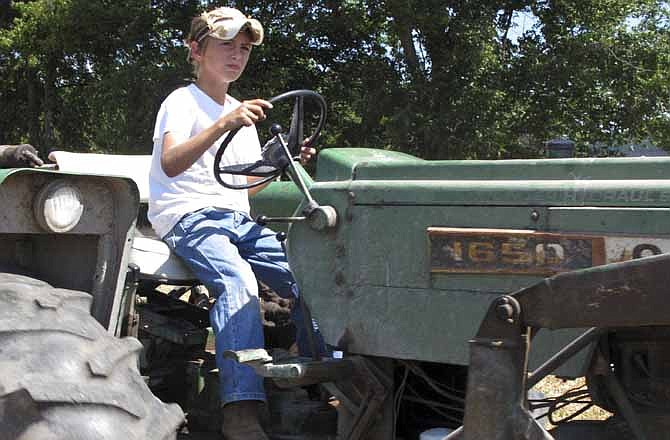
In a June 20, 2012, photo ten-year-old Jacob Mosbacher guides a tractor through a bean field on his grandparents' property near Fults, Ill. Agriculture organizations and federal lawmakers from farm states succeeded last spring in convincing the U.S. Labor Department to drop proposals limiting farm work by children such as Jacob, whose parents say such questions of safety involving kids should be left to parents.

In a June 20, 2012, photo ten-year-old Jacob Mosbacher guides a tractor through a bean field on his grandparents' property near Fults, Ill. Agriculture organizations and federal lawmakers from farm states succeeded last spring in convincing the U.S. Labor Department to drop proposals limiting farm work by children such as Jacob, whose parents say such questions of safety involving kids should be left to parents. Photo by The Associated Press.

As he watched his 10-year-old son ease a tractor across an Illinois soybean field, Dennis Mosbacher acknowledged the risks of farming.

But Mosbacher said the U.S. Labor Department was misguided in its attempts to protect children from farm accidents and he's relieved the agency dropped its plans this spring and has promised not to take up the matter again.

"You can't make a rule to stop every accident," Mosbacher said after his son Jacob hopped off the 40-year-old, 60-horsepower tractor at their farm near the tiny southern Illinois town of Fults. "There's always a risk in life, no matter what you do."

Labor Department officials don't deny that, but they note that children performing farm work are four times more likely to be killed than those employed in all other industries combined.

Under the Labor Department's failed proposal, paid farm workers would have to be 16 to use power equipment, such as tractors. They would have to be 18 to work at grain elevators, silos and feedlots. The rules would not have applied to children working at farms owned by their parents, but they would have limited the paid jobs youngsters could do on their neighbors' and relatives' farms.

John Myers, chief of the National Institute for Occupational Safety and Health Administration's surveillance and field investigations branch, said it's unfortunate the agency dropped its proposal in the face of intense opposition from agricultural groups. Agency officials have said they will not take up the matter again as long as Barack Obama is president.

"I have not seen any youth working in other industries that are at higher risk," Myers said. "(Farming) may be an accepted risk for the parent, but the question is to put that risk on the child. That's the question that's not being adequately addressed.

"If society says you have to be 16 to operate a car, I don't see how you can say it's any less sound advice that you have to be 16 to operate farm equipment," he added. "I suspect this will not be addressed again, and I suspect we will continue to have youths dying on farms each year in situations that were perfectly preventable."

The lack of action also troubles Cheryl Monen, who lives in the small northwestern Iowa community of Lester.

Had such child labor rules been in place a year ago, her 17-year-old son might still be alive.

Jordan Monen was into his second summer working on a cattle farm in July 2011 when he climbed into the bucket of a payloader and was hoisted up to fix the top railing on a cattle shed's sliding door. The machine lunged forward and smashed the teen's face between the railing and the back of the bucket. He then hit a cement feed trough as he tumbled to the ground.

The boy was taken to a hospital, where he was declared dead of severe head trauma.

A year later, his mother remains haunted about her decision to let her son take the job.

"I feel so guilty about it now. I just had not put it together how terribly dangerous it was and the risks he was in," Monen said. "I really struggle with that. Now, I really wish I never suggested he get a job."

Monen now thinks anyone younger than 18 should be barred from working on a farm "because they don't recognize the dangers." She also said children shouldn't be allowed to work on farms and ranches not owned by their parents.

"If they wanna have their own kids in there, go for it," she said.

The push for tougher restrictions came at a time when fewer children are being injured on farms.

For every 1,000 U.S. farms, agriculture-related injuries to workers younger than 20 dropped by nearly half from 2001 to 2009, from 13.5 injuries to 7.2 injuries, according U.S. government figures. Injuries were most common among children ages 10 to 15, but they also dropped by nearly half during that period.

Farming groups attribute such declines to farmers' and ranchers' greater awareness of risks, but they add that it's vital children begin farm work at an early age so safety requirements become engrained in them. Agriculture groups also note that rural children looking for summer jobs often have no option other than farm work and enhancing regulations could dampen kids' enthusiasm for becoming farmers.

"We're the first to recognize that farming can be dangerous, but broad, sweeping intervention is not the best way to go about addressing it," said Kristi Boswell, the congressional relations chief for the American Farm Bureau Federation, which opposed the Labor Department's push.

Debbie Mosbacher said the proposed federal rules didn't reflect the reality on farms, where children grow up understanding the dangers and are eased into risky chores.

She noted that for Jacob, that meant riding on the tractor in his father's lap when he was 4 and feeding livestock when the cattle still towered over him. Last year, he started driving the riding lawnmower.

When it comes to farm kids pitching in, "a lot of times, yes, it's a necessity," she said. "A 10-year-old may not be able to load a 70-pound bale. But everyone's got a job to do, and if you wait until they're 18 to teach them it won't be something that's instinctive in them."

Comments

JCLifer 10 months, 2 weeks ago

Look at the picture! No ROPS. No seat belt. Worn tires on an antique yractor. The kid cannot even sit in the seat properly and reach the controls. The parents of that child should be hot lined for putting that child in harm's way. What poor neglegent parents. I feel sorry for that abused kid.

0

no1knows 10 months, 2 weeks ago

JcLifer, arent you one of the ones always talking about the mis-spelled words? whats a yractor?

Anyhow. Even if they say you should be 16 to drive a tractor, then things like 4-wheelers shouldn't be allowed to drive as well. I know some young boys who have been on a farm their whole life, and are so much more advanced in many everyday life happenings because of the work ethic they have been taught and by driving that tractor since they were 7. They know responsibily, how to work, when they know they need to ask for help, and the concept thats no longer around.....how to help others. The old lady down the road had 15 inches of show in her drive..how was anyone supposed to get to her??? The 40 year old man next door sure wasnt going to help..who helped? That 10 year old on his grandpas tractor. Id rather have my kid hauling bales and using a tractor, than sitting in from of some stupid video game or riding 4 wheelers that are just as dangerous as anything else. ANYTHIGN is risky. A bicycle now days is "risky" but those are OK right? How many deaths a year..are recorded because someone hit a kid on a bike in their own driveway? Or have been backed over by a parent in their drive way because they were not paying attention to where the kid was or it was simply, and accident. How many kids do you see how on jet skis, that is WAY more dangerous. With the right supervision a 10 year old can do alot of things. But ive lived in this area my whole like, and i sure havent heard of many deaths of kids from farm equipment...

0

no1knows 10 months, 2 weeks ago

And "abused" kid? really? If thats what you call abuse...then I think you might want to look around...you obviously have never had to work on a farm. Its not abuse. Some of those kids are proud of what they can do.

0

PatsyDecline 10 months, 2 weeks ago

That kid isn't "working".

That kid is Living.

The world would be a much better place if every kid got the opportunity to spend a summer or two "working" a farm.

0

viktorkowski 10 months, 2 weeks ago

I think in missouri they refer to those kids as "migrant labor".

0

newone 10 months, 2 weeks ago

I agree, I think all kids need to be subjected to this type of labor, teach them what real work is!! Real work isn't standing around McDonalds doing nothing like I see a lot of young kids doing!

0

TickledPink 10 months, 2 weeks ago

I helped out on my grandparents' farm when I was a kid and those are some of the best memories of my childhood. Getting up in the morning and going down to get the eggs for breakfast, feeding the cows, baling hay. My sons haven't had those experiences and I always thought it was a shame.

0

interesting 10 months, 2 weeks ago

It depends on the family and kids. I have learned from experience that most good farmers are extremely fit from all the farm labor and their children fit the same mold. However, I found the overweight so called farmers were extremely lazy and sloppy. Their relatives tended to have these same characteristics. I would worry about these children on farm equipment. Farming is the Ultimate Lifestyle!!!!!!!!!

0

Littleinvestor 10 months, 2 weeks ago

ROPS and seat belts should be used on every tractor and retrofit ones are available for many "antique" tractors. I would not operate a tractor without the safety equipment and sure would not want one of my kids or grandkids on such a tractor. In my extended family, you don't operate farm equipment until your legs are long enough to comfortably reach the pedals and you can understand how to use the clutch and wheel brakes correctly. Safety shields are always in place on the PTOs when the equipment in use, even though they can be a pain. We know too many farmers who have been horribly injured or killed in farming accidents.

0

Please review our Policies and Procedures before registering or commenting