
A group wanting to replace Missouri's income tax with a higher and broader sales tax said Thursday it is committed to getting the initiative on the November ballot, but declined to say how many millions of dollars it is willing to spend to try to persuade voters to support it.
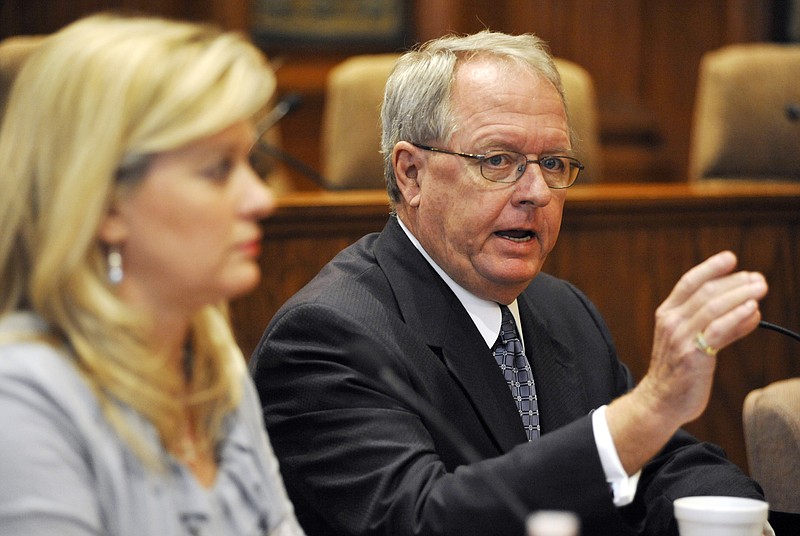
The proposed tax change prompted a spirited debate Thursday at the Missouri Capitol between an advocate who claimed it could spur Missouri's economy and an opponent who contended it would result in a tax break for the wealthy at the expense of lower-and moderate-income families.
The initiative would abolish Missouri's individual income tax, which currently provides the greatest portion of the state's general revenues, and instead require the Legislature to expand the state's current 4.25 percent sales tax. The new state sales tax rate could go up to 7 percent, and the combined state and local sales tax rate would be capped at 10 percent. But the tax would be charged to a wider variety of goods and services.
The group Let Voters Decide already has received about $2.5 million for the initiative from Missouri businessman Rex Sinquefield, who two years ago helped bankroll a ballot initiative requiring periodic voter approval of earnings taxes in St. Louis and Kansas City.
Anne Marie Moy, a spokeswoman for Let Voters Decide, declined to say how much the group was willing to spend on the income-and-sales tax initiative. But she stressed that after years of discussing the proposal, the group was serious about gathering enough petition signatures to qualify the measure for a statewide vote this November.
"We absolutely are committed to getting this on the ballot," Moy told media gathered at the Capitol for an event sponsored by The Associated Press and Missouri Press Association.
Moy cited figures indicating Missouri ranked 48th in growth of its gross domestic product, which she called "shameful" and "embarrassing." She said some states without income taxes, including Tennessee, were faring better economically while also gaining more population. Repealing Missouri's income tax "will help us to reverse our loss of jobs and wealth," she said.
Jim Moody, a consultant for the opposition group Missourians for Fair Taxation, countered with figures showing that although Tennessee doesn't have an individual income tax, it imposes a variety of other taxes that Missouri does not. Moody suggested that by at least one measure of wealth, Tennessee residents were poorer than Missourians. He said a higher sales tax would disproportionately affect the poor while creating an unstable funding source for the state.
"Tying yourself to the sales tax here is kind of like putting an anchor around your neck and throwing it out the window: You're going to die," Moody said.
Asked later about the ballot initiative, Democratic Gov. Jay Nixon indicated he also opposed it.
"The bottom line is I don't support raising taxes on groceries and other critical things that families need," Nixon said. "Making families pay more for bread and milk doesn't seem like a solid step forward for our economy."
During their debate about the initiative, Moody and Moy clashed frequently and occasionally talked over the top of each other.
Moody suggested repealing the individual income tax and replacing it with a higher sales tax would encourage a "web of tax avoidance" in Missouri. Moody, who lives in Jefferson City, said it might lead him to incorporate his business in another state and then pay himself as an employee.
Moy interjected: "That's one scoundrelsy sort of route to take."
Moy said she did not believe a higher sales tax would cause Missouri residents in border towns to do their shopping in neighboring states. She said supporters of the initiative conducted an experiment in which they loaded 70 people on a bus, gave them $100 to spend at a Walmart in Missouri, and an additional $100 to spend on the same items at a Wal-Mart in Tennessee. She said every participant agreed afterward that the sales tax difference would not be enough to cause them to cross the border for their shopping.
"People shop where they live," Moy said.
Online:
Each side's slide presentations are posted at http://mopress.com/legislative.php?blog_id=64
News Tribune Facebook Question:
A group wanting to replace Missouri's income tax with a higher and broader sales tax says it is committed to getting the initiative on the November ballot. The proposed tax change prompted a spirited debate at the Capitol between an advocate who claimed it could spur Missouri's economy and an opponent who contended it would result in a tax break for the wealthy. Would you support the tax change?
Comment and read others' opinions on our Facebook page.