
Shooting renews argument over video-game violence
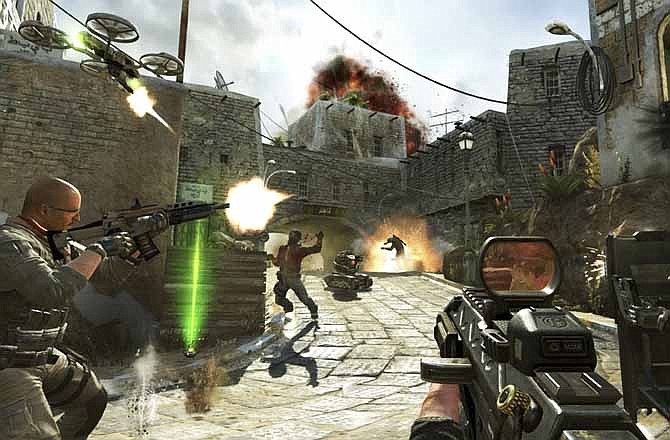
This undated publicity image released by Activision shows soldiers and terrorists battling in the streets of Yemen in a scene from the video game, “Call of Duty: Black Ops II.” Video-game violence has come under increased scrutiny after the killing of 26 people, including 20 children, in a Connecticut elementary school last week. Photo by The Associated Press.
Thursday, December 20, 2012
WASHINGTON (AP) — In the days since the massacre at Sandy Hook Elementary School in Newtown, Conn., a shell-shocked nation has looked for reasons. The list of culprits cited include easy access to guns, a strained mental-health system and the "culture of violence" — the entertainment industry's embrace of violence in movies, TV shows and, especially, video games.
"The violence in the entertainment culture — particularly, with the extraordinary realism to video games, movies now, et cetera — does cause vulnerable young men to be more violent," Sen. Joe Lieberman, I-Conn., said.
"There might well be some direct connection between people who have some mental instability and when they go over the edge — they transport themselves, they become part of one of those video games," said Gov. John Hickenlooper of Colorado, where 12 people were killed in a movie theater shooting in July.
White House adviser David Axelrod tweeted, "But shouldn't we also quit marketing murder as a game?"
And Donald Trump weighed in, tweeting, "Video game violence & glorification must be stopped — it is creating monsters!"
There have been unconfirmed media reports that 20-year-old Newtown shooter Adam Lanza enjoyed a range of video games, from the bloody "Call of Duty" series to the innocuous "Dance Dance Revolution." But the same could be said for about 80 percent of Americans in Lanza's age group, according to the Pew Internet and American Life Project. Law enforcement officials haven't made any connection between Lanza's possible motives and his interest in games.
The video game industry has been mostly silent since Friday's attack, in which 20 children and six adults were killed. The Entertainment Software Association, which represents game publishers in Washington, has yet to respond to politicians' criticisms. Hal Halpin, president of the nonprofit Entertainment Consumers Association, said, "I'd simply and respectfully point to the lack of evidence to support any causal link."
It's unlikely that lawmakers will pursue legislation to regulate the sales of video games; such efforts were rejected again and again in a series of court cases over the last decade. Indeed, the industry seemed to have moved beyond the entire issue last year, when the Supreme Court revoked a California law criminalizing the sale of violent games to minors.
The Supreme Court decision focused on First Amendment concerns; in the majority opinion, Justice Antonin Scalia wrote that games "are as much entitled to the protection of free speech as the best of literature." Scalia also agreed with the ESA's argument that researchers haven't established a link between media violence and real-life violence. "Psychological studies purporting to show a connection between exposure to violent video games and harmful effects on children do not prove that such exposure causes minors to act aggressively," Scalia wrote.
Still, that doesn't make games impervious to criticism, or even some soul-searching within the gaming community. At this year's E3 — the Electronic Entertainment Expo, the industry's largest U.S. gathering — some attendees were stunned by the intensity of violence on display. A demo for Sony's "The Last of Us" ended with a villain taking a shotgun blast to the face. A scene from Ubisoft's "Splinter Cell: Blacklist" showed the hero torturing an enemy. A trailer for Square Enix's "Hitman: Absolution" showed the protagonist slaughtering a team of lingerie-clad assassins disguised as nuns.
"The ultraviolence has to stop," designer Warren Spector told the GamesIndustry website after E3. "I do believe that we are fetishizing violence, and now in some cases actually combining it with an adolescent approach to sexuality. I just think it's in bad taste. Ultimately I think it will cause us trouble."
"The violence of these games can be off-putting," Brian Crecente, news editor for the gaming website Polygon, said Monday. "The video-game industry is wrestling with the same issues as movies and TV. There's this tension between violent games that sell really well and games like 'Journey,' a beautiful, artistic creation that was well received by critics but didn't sell as much."
During November, typically the peak month for pre-holiday game releases, the two best sellers were the military shooters "Call of Duty: Black Ops II," from Activision, and "Halo 4," from Microsoft. But even with the dominance of the genre, Crecente said, "There has been a feeling that some of the sameness of war games is grating on people."
Critic John Peter Grant said, "I've also sensed a growing degree of fatigue with ultra-violent games, but not necessarily because of the violence per se."
The problem, Grant said, "is that violence as a mechanic gets old really fast. Games are amazing possibility spaces! And if the chief way I can interact with them is by destroying and killing? That seems like such a waste of potential."
There are some hints of a growing self-awareness creeping into the gaming community. One gamer — Antwand Pearman, editor of the website GamerFitNation — has called for other players to join in a "Day of Cease-Fire for Online Shooters" this Friday, one week after the massacre.
"We are simply making a statement," Pearman said, "that we as gamers are not going to sit back and ignore the lives that were lost."


Comments
linoge 5 months ago
There is plenty of evidence to support the correlation between violent video games and violent behaviors in adolescents. The difference between the games and real-life is, of course, that in real life you cannot simply hit the reset button.
newone 5 months ago
At what point should parents start taking responsibility in what their child does, I understand these games are violent but they are rated for a reason and if a parent doesn't listen to those ratings then how is that the game makers fault?
asb 5 months ago
There is also evidence refuting a strong game/violence connection. The problem is filtering out other factors. There is ample proof that people distinguish games from life instinctively, and that ability is older than being human. Objective study, yep - another study - on the nature of play as a precursor to behavior is needed. Children use sticks and faux guns in war games and home defense rituals as young as five and six years. Sorry, but the so-called obvious connection between video games and violent behavior is lost in the noise of violent sports, entertainment, childhood games, and competitive behavior in general. Simple answers only exist in games.
linoge 5 months ago
Sounds flimsy to me.
Sequoia 5 months ago
Interesting that people in Canada and Great Britian are able to watch the same movies and play the same video games without going out and shooting each other.
What's the difference? The number of assault weapons in our respective societies.
bluesfan13 5 months ago
Whoa there... You're a huge pundit about how America's downfall is BECAUSE we're trying to be more like socialist Canada. Now their socitey is better than ours? You can't have it both ways.
MO4LIFE 5 months ago
Then move there GRACE since you constantly spew your hatred of america
asb 5 months ago
Grace's continued hatred of America . . . the difference between the character of America and Canada is measurable? And since you imply that Canad's character is superior to America's, what's the reason? Race? Climate? Jesus? What is it Grace?
JCLifer 5 months ago
I have lived in Canada and I also have several friends there. I don't know what the difference is exactly, but it does seem that the several Canadians I know have a lot less anxiety about everyday things than we do. They do not seem to be so worried about what their leaders are going to do to them like we are. They also have a much more global outlook and awareness of what is going on around the world than we do.
They seem to not worry and stress much about losing their good-paying jobs, and they seem to feel confident that their government has enough checks and balances to prevent things from going wrong because of one party or another. They also don't seem to have all the poverty and dependents like we do- everyone there seems to work and pull his/her own way, and they do a better job of sharing the work so the line between the haves and have-nots is not as sharp, I don't hear of people there working 80 hours a week trying to make ends meet, and lots of other people unemployed.
They also have a Tim Hortons on every corner, so they have lots of yummy donuts and coffee to go around. Their food, especially dairy products, is much tastier than ours- like they have higher standards of quality. Cream is creamier, butter tastes like very rich butter, etc. Their beer is tastier, even their Coke formulation is sweeter than ours. They have better cigars (from Cuba), and even poor people are easily able to afford international travel for their hoiday (vacation) each year.
I don't think they play as many violent video games as we do, nor do I think rap music is as popular.
The perception of Candadians is that everyone in the U.S. has a handgun on them at all times. They are convinced we need our hand guns because our culture is so much more violent than theirs. They think we live in a wild west society,
John 5 months ago
For those who maintain movies, television, and the like do NOT affect minds and actions please explain to me why study after studty after study has resulted in the OVERWHELMING evidence that commercials sell product and DO influence behavior?
Are you suggesting that billions upon billions of dollars are spent on a media vehicle that does not work?
Sequoia 5 months ago
Well, there is a difference between asserting that advertising works and asserting that viewing violent images cause people to act violently.
Actually, there is no research indicating that watching violence causes people to behave violently. I'm not saying that we aren't affected by the images and ideas we consume (I believe media is like food in that way... you are what you eat) but I think there are too many variables involved.
This hand-wringing about "culture" and "character" just diverts from the real issue: We allow weapons manufacturers to sell military equipment to civilians. No other country does. That's the difference.
Read here: ideas.time.com/2012/12/20/sandy-hook-shooting-video-games-blamed-again/
Quote: "As a video game violence researcher and someone who has done scholarship on mass homicides, let me state very emphatically: There is no good evidence that video games or other media contributes, even in a small way, to mass homicides or any other violence among youth."
Instead of simply asserting that somewhere there exists "overwhelming evidence" to support your position, please actually link to that evidence.
Thanks.
John 5 months ago
Actually, very few military grade weapons are sold to civillians. Even when they are -- they are limited to small caiibler, high power, automatic rifles and even then, ONLY, to special license holders who have undergone extensive background checks and interviews.
Data, you ask? Why try the National Association of Broadcasters. They have been studying this very thing and studying data for 40 years. . . .
If commercials sell product, especially when using repitition, then repeated violent acts in a game sell violence.
Please review our Policies and Procedures before registering or commenting
Or login with:
OpenID