
MILWAUKEE (AP) - Is a gun like a virus, a car, tobacco or alcohol? Yes say public health experts, who in the wake of recent mass shootings are calling for a fresh look at gun violence as a social disease.
What we need, they say, is a public health approach to the problem, like the highway safety measures, product changes and driving laws that slashed deaths from car crashes decades ago, even as the number of vehicles on the road rose.
One example: Guardrails are now curved to the ground instead of having sharp metal ends that stick out and pose a hazard in a crash.
"People used to spear themselves and we blamed the drivers for that," said Dr. Garen Wintemute, an emergency medicine professor who directs the Violence Prevention Research Program at the University of California, Davis.
It wasn't enough back then to curb deaths just by trying to make people better drivers, and it isn't enough now to tackle gun violence by focusing solely on the people doing the shooting, he and other doctors say.
They want a science-based, pragmatic approach based on the reality of a society saturated with guns and seek better ways of preventing harm from them.
The need for a new approach crystallized last Sunday for one of the nation's leading gun violence experts, Dr. Stephen Hargarten. He found himself treating victims of the Sikh temple shootings at the emergency department he heads in Milwaukee. Seven people were killed, including the gunman, and three were seriously injured.
It happened two weeks after the shooting that killed 12 people and injured 58 at a movie theater in Colorado, and two days before a man pleaded guilty to killing six people and wounding 13, including then-Rep. Gabrielle Giffords, in Tucson, Ariz., last year.
"What I'm struggling with is, is this the new social norm? This is what we're going to have to live with if we have more personal access to firearms," said Hargarten, emergency medicine chief at Froedtert Hospital and director of the Injury Research Center at the Medical College of Wisconsin. "We have a public health issue to discuss. Do we wait for the next outbreak or is there something we can do to prevent it?"
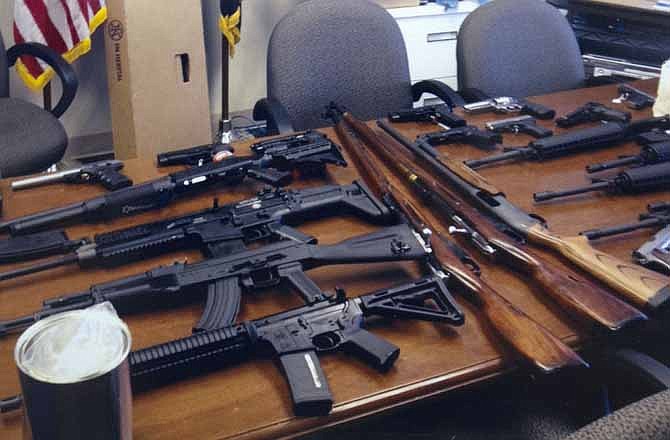
About 260 million to 300 million firearms are owned by civilians in the United States; about one-third of American homes have one. Guns are used in two-thirds of homicides, according to the FBI. About 9 percent of all violent crimes involve a gun - roughly 338,000 cases each year.
Mass shootings don't seem to be on the rise, but not all police agencies report details like the number of victims per shooting and reporting lags by more than a year, so recent trends are not known.
"The greater toll is not from these clusters but from endemic violence, the stuff that occurs every day and doesn't make the headlines," said Wintemute, the California researcher.
More than 73,000 emergency room visits in 2010 were for firearm-related injuries, the Centers for Disease Control and Prevention estimates.
At the same time, violent crime has been falling and the murder rate is less than half what it was two decades ago. And Gallup polls have shown support for stricter gun laws has been falling since 1990. Last year 55 percent of Americans said gun laws should remain the same or become more lenient.
Dr. David Satcher tried to make gun violence a public health issue when he became CDC director in 1993. Four years later, laws that allow the carrying of concealed weapons drew attention when two women were shot at an Indianapolis restaurant after a patron's gun fell out of his pocket and accidentally fired. Ironically, the victims were health educators in town for an American Public Health Association convention.
That same year, Hargarten won a federal grant to establish the nation's first Firearm Injury Center at the Medical College of Wisconsin.
"Unlike almost all other consumer products, there is no national product safety oversight of firearms," he wrote in the Wisconsin Medical Journal.
That's just one aspect of a public health approach. Other elements:
-"Host" factors: What makes someone more likely to shoot, or someone more likely to be a victim. One recent study found firearm owners were more likely than those with no firearms at home to binge drink or to drink and drive, and other research has tied alcohol and gun violence. That suggests that people with driving under the influence convictions should be barred from buying a gun, Wintemute said.
-Product features: Which firearms are most dangerous and why. Manufacturers could be pressured to fix design defects that let guns go off accidentally, and to add technology that allows only the owner of the gun to fire it (many police officers and others are shot with their own weapons). Bans on assault weapons and multiple magazines that allow rapid and repeat firing are other possible steps.
-"Environmental" risk factors: What conditions allow or contribute to shootings. Gun shops must do background checks and refuse to sell firearms to people convicted of felonies or domestic violence misdemeanors, but those convicted of other violent misdemeanors can buy whatever they want. The rules also don't apply to private sales, which one study estimates as 40 percent of the market.
-Disease patterns, observing how a problem spreads. Gun ownership - a precursor to gun violence - can spread "much like an infectious disease circulates," said Daniel Webster, a health policy expert and co-director of the Johns Hopkins Center for Gun Policy and Research in Baltimore.
"There's sort of a contagion phenomenon" after a shooting, where people feel they need to have a gun for protection or retaliation, he said.
That's already evident in the wake of the Colorado movie-theater shootings. Last week, reports popped up around the nation of people bringing guns to "Batman" movies. Some of them said they did so for protection.
Associated Press writer Pete Yost in Washington contributed to this report.
Online:
Violence prevention research: http://www.ucdmc.ucdavis.edu/vprp
CDC injury prevention: http://www.cdc.gov/violenceprevention/nvdrs/