
Horses could soon be butchered in the U.S. for human consumption after Congress quietly lifted a 5-year-old ban on funding horse meat inspections, and activists say slaughterhouses could be up and running in as little as a month.
Slaughter opponents pushed a measure cutting off funding for horse meat inspections through Congress in 2006 after other efforts to pass outright bans on horse slaughter failed in previous years. Congress lifted the ban in a spending bill President Obama signed into law Nov. 18 to keep the government afloat until mid-December.
It did not, however, allocate any new money to pay for horse meat inspections, which opponents claim could cost taxpayers $3 million to $5 million a year. The U.S. Department of Agriculture would have to find the money in its existing budget, which is expected to see more cuts this year as Congress and the White House aim to trim federal spending.
The USDA issued a statement Tuesday saying there are no slaughterhouses in the U.S. that butcher horses for human consumption now, but if one were to open, it would conduct inspections to make sure federal laws were being followed. USDA spokesman Neil Gaffney declined to answer questions beyond what was in the statement.
The last U.S. slaughterhouse that butchered horses closed in 2007 in Illinois, and animal welfare activists warned of massive public outcry in any town where a slaughterhouse may open.
"If plants open up in Oklahoma or Nebraska, you'll see controversy, litigation, legislative action and basically a very inhospitable environment to operate," predicted Wayne Pacelle, president and chief executive of The Humane Society of the United States. "Local opposition will emerge and you'll have tremendous controversy over slaughtering Trigger and Mr. Ed."
But pro-slaughter activists say the ban had unintended consequences, including an increase in neglect and the abandonment of horses, and they are scrambling to get a plant going - possibly in Wyoming, North Dakota, Nebraska or Missouri. They estimate a slaughterhouse could open in 30 to 90 days with state approval and eventually as many as 200,000 horses a year could be slaughtered for human consumption. Most of the meat would be shipped to Europe and Asia, where it's treated as a delicacy.
Dave Duquette, president of the nonprofit, pro-slaughter group United Horsemen, said no state or site has been picked yet but he's lined up plenty of investors who have expressed interest in financing a processing plant. While the last three slaughterhouses in the U.S. were owned by foreign companies, he said a new plant would be American-owned.
"I have personally probably five to 10 investors that I could call right now if I had a plant ready to go," said Duquette, who lives in Hermiston, Ore. He added, "If one plant came open in two weeks, I'd have enough money to fund it. I've got people who will put up $100,000."
Sue Wallis, a Wyoming state lawmaker who's the group's vice president, said ranchers used to be able to sell horses that were too old or unfit for work to slaughterhouses but now they have to ship them to butchers in Canada and Mexico, where they fetch less than half the price.
The federal ban devastated "an entire sector of animal agriculture for purely sentimental and romantic notions," she said.
Although there are reports of Americans dining on horse meat a recently as the 1940s, the practice is virtually non-existent in this country, where the animals are treated as beloved pets and iconic symbols of the West.
Lawmakers in California and Illinois have banned the slaughter of horses for human consumption, and more than a dozen states tightly regulate the sale of horse meat.
Federal lawmakers' lifting of the ban on funding for horse meat inspections came about in part because of the recession, which struck just as slaughtering stopped. A federal report issued in June found that local animal welfare organizations reported a spike in investigations for horse neglect and abandonment since 2007. In Colorado, for example, data showed that investigations for horse neglect and abuse increased more than 60 percent - from 975 in 2005 to almost 1,600 in 2009.
The report from the U.S. Government Accountability Office also determined that about 138,000 horses were transported to Canada and Mexico for slaughter in 2010, nearly the same number that were killed in the U.S. before the ban took effect in 2007. The U.S. has an estimated 9 million horses.
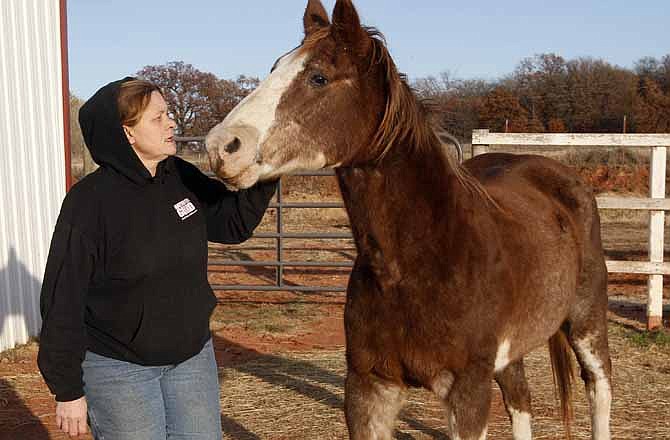
Cheri White Owl, founder of the nonprofit Horse Feathers Equine Rescue in Guthrie, Okla., said she's seen more horse neglect during the recession. Her group is caring for 33 horses now and can't accept more.
"A lot of the situation is due to the economy," she said, "People deciding to pay their mortgage or keep their horse."
But White Owl worries that if slaughterhouses open, owners will dump their unwanted animals there instead of looking for alternatives, such as animal sanctuaries.
Animal rights groups also argue that slaughtering is a messy, cruel process, and some say it would be kinder for owners to have their horses put to sleep by a veterinarian.
"Euthanasia has always been an option," Pacelle said. But "if you acquire a horse, you should be a responsible owner and provide lifetime care."
The fight over horse slaughtering has pitted lawmakers of the same party against each other.
Sen. Max Baucus, D-Mont., said the poor economy has resulted in "sad cases" of horse abandonment and neglect and lifting the ban will give Americans a shot at regaining lost jobs and making sure sick horses aren't abandoned or mistreated.
But U.S. Rep. Jim Moran, D-Va., is lobbying colleagues to permanently ban horse slaughter because he believes the process is inhumane.
"I am committed to doing everything in my power to prevent the resumption of horse slaughter and will force Congress to debate this important policy in an open, democratic manner at every opportunity," he said in a statement.